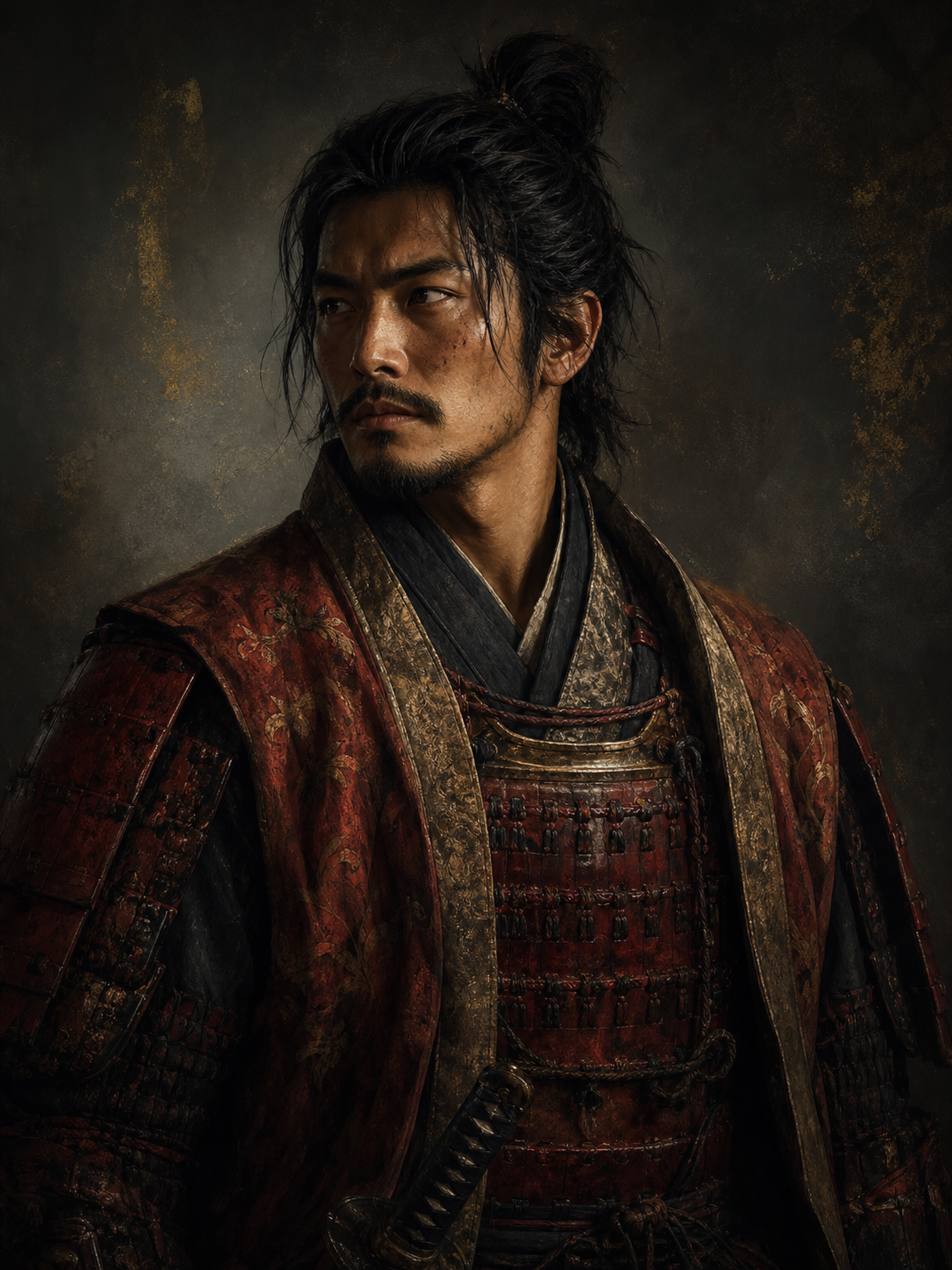
Who was Nobushige?
Sanada Nobushige (1567–1615) is the most romanticised warrior of the Sengoku period, and the one whose fame rests almost entirely on how he died. He spent most of his life as a hostage, a minor commander and an exile. Then, in the final battle of the era, he led a charge that broke through the Tokugawa lines and came close to reaching Tokugawa Ieyasu himself.
He is usually called Sanada Yukimura in games, novels and drama. That name does not appear in documents from his lifetime; it was attached to him by Edo-period popular literature and became standard. He signed himself Nobushige, and this site uses both.
Why is Nobushige important?
- He designed and held the Sanada Maru, an outwork of Osaka Castle that inflicted heavy losses on the besieging Tokugawa army in 1614.
- His final charge in 1615 reached Ieyasu's headquarters, an event the Tokugawa side itself recorded with alarm.
- A Shimazu retainer's letter called him "the number one warrior in Japan", which is where his enduring reputation begins.
- He became the model for the loyal-underdog hero in Japanese popular culture, and the Sanada name carries that meaning to this day.
A hostage's early life
The Sanada were a small house in Shinano Province squeezed between the Takeda, Uesugi, Hojo and Tokugawa. Survival meant switching allegiance repeatedly, and Nobushige spent years as a hostage — first with the Uesugi, then in Toyotomi Hideyoshi's service, where he married the daughter of a senior Toyotomi retainer.
His father Sanada Masayuki made the family's reputation by defeating Tokugawa armies at Ueda Castle twice. Nobushige fought in the second of these, the Second Battle of Ueda in 1600, which delayed Ieyasu's son Hidetada and kept 38,000 troops away from Sekigahara.
Exile
The Sanada had deliberately split: Nobushige and his father joined the Western side in 1600, while his elder brother Sanada Nobuyuki — married to a daughter of Honda Tadakatsu — stood with the Tokugawa. Whatever the outcome, the house would survive.
It did. Masayuki and Nobushige were spared execution at Nobuyuki's request and exiled to Kudoyama in the mountains of Kii Province, where they lived under guard for fourteen years. Masayuki died there. Nobushige was still there in 1614, aged forty-seven, when the Toyotomi sent agents to recruit veterans for the coming war.
Osaka and his death
He slipped out of Kudoyama and entered Osaka Castle. During the winter campaign of 1614 he built the Sanada Maru, a semicircular fortified outwork covering the castle's weakest approach, and used it to bleed the Tokugawa assault badly. See Siege of Osaka.
After the castle's outer defences were dismantled under the truce, the summer campaign of 1615 was fought in the open, where the defenders had no chance. At Tennoji, Nobushige led a concentrated charge straight at Ieyasu's command position. Tokugawa accounts admit the headquarters standard was knocked down and Ieyasu's guard scattered. The charge failed; Nobushige, exhausted and wounded, was killed shortly afterwards.
Legacy
The Shimazu retainer's often-quoted line — that Sanada was "the number one warrior in Japan" — comes from a letter written soon after the battle, which is why it carries more weight than most such praise.
From the Edo period onward, storytellers built an entire hero out of him, complete with a band of ten legendary followers including the ninja Sarutobi Sasuke and Kirigakure Saizo. Those characters are fiction. The historical man was a middle-aged exile who took an impossible job and did it better than anyone expected.